Monon Rahman fell in love with racing and knew it was what he wanted to do for a career. From late nights in Kentucky to building a career as an engineer with Joe Gibbs Racing, he has always been involved with the sport.
While he didn’t get behind the wheel growing up, he recalls his time in high school when he realized his dream was to work in racing.
“When you are watching TV or playing racing games, the two main guys are the driver and the crew chief. I knew that I wasn’t going to be the driver, but I wanted to be one of the key guys, so engineering was the best path forward to me,” Rahman explained.
The dream led Rahman to attending University of Kentucky, where he got involved early with their Formula SAE and solar car teams.
“Those two programs where the only two things I had in Kentucky growing up, so I made sure to pour my heart and soul into them,” he said. In that time, he crafted skills that would him continue his goals of working in racing. While he worked on the technical side of these programs, he also noted his experience from a management side as well.
“I was involved more on the fundraising, marketing, and management side of the program; getting that management background and understanding how to pitch these student programs and learning how to help them grow has really helped me throughout the Legends Car process.”
Though heavily involved in these student programs, Rahman looked to get involved beyond the university. He started cold emailing different NASCAR Cup Series teams with the goal of landing a valuable internship. During his search, he noted a lack of response from teams he was interested in working with. His luck changed after a conversation with current NASCAR CRAFTSMAN Truck Series driver Ben Rhodes, who visited the University of Kentucky. Rhodes had told him to reach out to Venturini Motorsports in the ARCA Menards Series, a team he had formerly driven for. “I remember it was one of the last teams I reached out to and I got a response within about an hour.” He said.
At the time they didn’t have a position in engineering, but his experience with camera work is what opened a door for him. “They found a way to pay me to get to the track to help in practice with camera work, and camera analysis of their cars and I was able to shadow the whole weekend. That was my whole start in racing, and it didn’t even start on the engineering side.”.
Now with his foot in the door and graduating in 2019, Rahman set his sights for Charlotte knowing that he was going to make it work. He spent 10 weeks interning at NASCAR working in R&D and recalled his time while looking for a full-time job saying, “After it ended, I was still trying to find a full-time job. I put all my eggs into this basket, and it took me a few months to find something because at this time, people where pretty saturated and there weren’t a lot of engineering jobs moving around.”
During this time, he met Brad Perez, who was working at Rick Ware Racing (RWR). After shadowing an event with RWR, he was brought on to support in both NASCAR and IMSA. Shortly after, the world changed in 2020 with the COVID-19 Pandemic leaving the world and its professional sports in a state of limbo. After navigating the unique season of racing in 2020 and hoping to stay in NASCAR, he found an opportunity from a familiar face, Venturini Motorsports.
“Near the end of 2020 Billy [Venturini] called me up and said they had a structured engineer role and that Toyota is going all in with all the sim tools.”
Being brought into a small team, Rahman was given the keys to the castle with the Toyota Race Development Sim tools. With the 2021 and 2022 seasons laying the groundwork with these tools, the 2023 season was where it all clicked, “We really ramped up our race wins in 2023, and we were able to win the drivers and owners championship, beating my current employer in JGR.”
Not only did the team see success but so did Rahman, earning his first win as a crew chief in the ARCA Series at Kevin Harvick’s Kern Raceway. This was the time that he grew the most in his professional career, saying, “I have a lot of respect for Billy, professionally he has done so much for me in my career, getting me into the Toyota Racing side of things. The tools I use now, the base is all the same route of what I was doing on the ARCA side.”
After spending three years with Venturini, in 2024 Rahman made his way through the Toyota pipeline being hired at Joe Gibbs Racing (JGR). He started as a race engineer in the NASCAR Xfinity Series (now NASCAR O’Reilly Auto Parts Series), working on the 20 car which was driven by multiple NASCAR drivers including Christopher Bell, Ty Gibbs, Aric Almirola, and John Hunter Nemechek.
In 2025 he worked as race engineer for Taylor Gray, being a part of his first win at Martinsville in October of the same year. He found that experience similar to his time in ARCA saying, “It’s a whole different atmosphere, you have a younger driver, trying to develop them, and to get the first win with them it feels so special.” For the 2026 season he transitioned into a shop role, to learn the NASCAR Cup Series cars, which has been his ultimate goal.
“It’s given me a new perspective, working with all of our race engineers and other support engineering groups, because there is a lot of different things you can learn when you aren’t on the road and always in crunch time. I miss being at the track every week, but it has given me a lot of background experience that will help me down the road and also given me an opportunity to race on my own with Legend cars.”
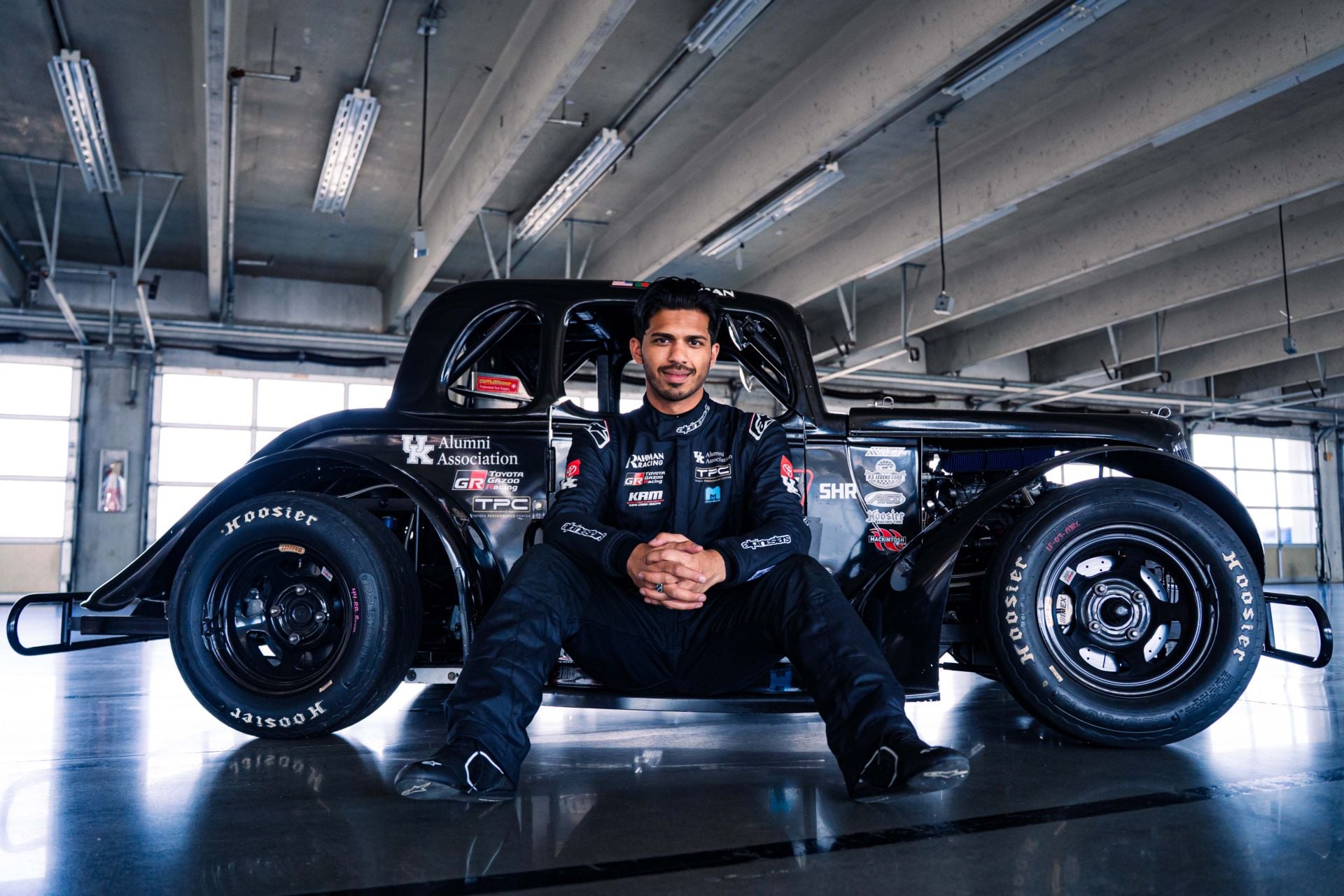
Knowing he was moving to a shop role for the next season, in late 2025, Rahman began looking for the opportunity to race Legend Cars. He found a spot with Ryan Mackintosh, who has helped him throughout his journey so far.
“He’s been awesome to work with. You can tell he puts a lot of investments in his equipment and cars. He helped knowing I have no seat time and that it was going to take time for me to get acclimated to the car” he said. With the support from both Mackintosh, and fundraising support from University of Kentucky alumni groups he set his eyes on competing on the track.
After early testing at Florence Motor Speedway and on iRacing, he wanted to test himself by competing in Winter Heat on the Charlotte Motor Speedway ROVAL.
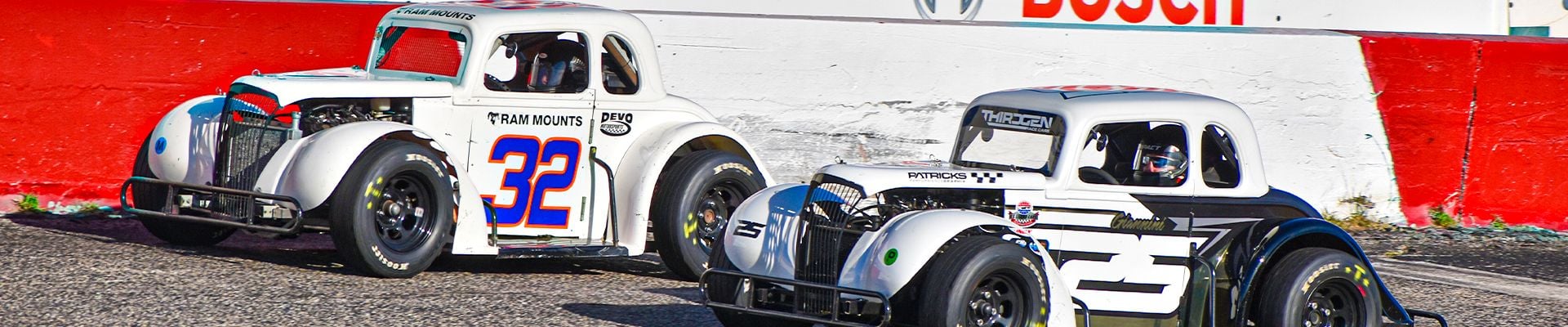
“I thought it could be a good reset for everyone being a new track and everyone not knowing the layout. So, I kind of felt like I could go into it and not be the worst one in the group.”. He competed in the Semi-Pro division and made his debut in the first three rounds of the event. He posted results of 27th, 22nd, and 18th in his first three races of his Legend Car career, improving each time he drove onto the famed Charlotte asphalt.
“I felt like I was in decent shape for where I was at. I hate the way the races went, I made some rookie mistakes early on,” he said.
“All in all, pace wise I was happy, with the prep and where it got me. I felt like I was mid pack in the chaos of it all, but it was reasonable to where I was going to be. I knew there would be people that would be three seconds faster than me, because they do it full time and race every week. I didn’t go into thinking I was going to set pole and win the races.”
He also found lessons to take away as an engineer too, adding, “Understanding the perspective both physically and mentally as a driver is helping me understand the approach to communication with the guys we work with. On the engineering side we get carried away with how easy it can be at time.
“Looking at the simulator and the live data, and it’s easy to say that the driver needs to break 100 feet deeper. Putting the helmet on and in a car, your heart rate is 170 bpm and you’re hot and sweaty hoping the driver next to you is checking their mirrors. It completely changes the whole picture of what it is like mentally. The good drivers we see on Saturdays and Sundays are able to process so much information quickly and they still will talk on the radio all while going 190 mph into a corner.”
Having competed in Winter Heat, he now has set his eyes on the Cook Out Summer Shootout. While the number of races he has run is low, he feels like he can learn a lot from these races.
“It’s such a unique race and track, that you really need to understand the race craft behind it all. What I need to learn for the B Main and A Main is how to survive and not get wrecked, and also how to overtake drivers.”
Preparing is one aspect of getting ready for the Summer Shootout, but Rahman has also spent some time fundraising for the event. He promotes his journey through motorsports via his social media. He also has been supported by UK alumni groups, along with TRD.
“TRD has been so excited with my progress and doing this on my own so they are covering the two Summer Shootout events I will be competing in, so we will have TRD on the car,” Rahman shared.
“It’s been cool to see their involvement and their investment in me from my time at Venturini to now”.
Racing beyond the Summer Shootout, whether in a Legend Car or something else, will depend on funding and Rahman would like to do so in equipment he knows is up to the task. His path to climbing behind the wheel of a race car is his own and unique compared to many racing Legend Cars. More important than the journey, Rahman actively demonstrates that with hard work and determination, dreams that you never thought were possible actually are well within reach.