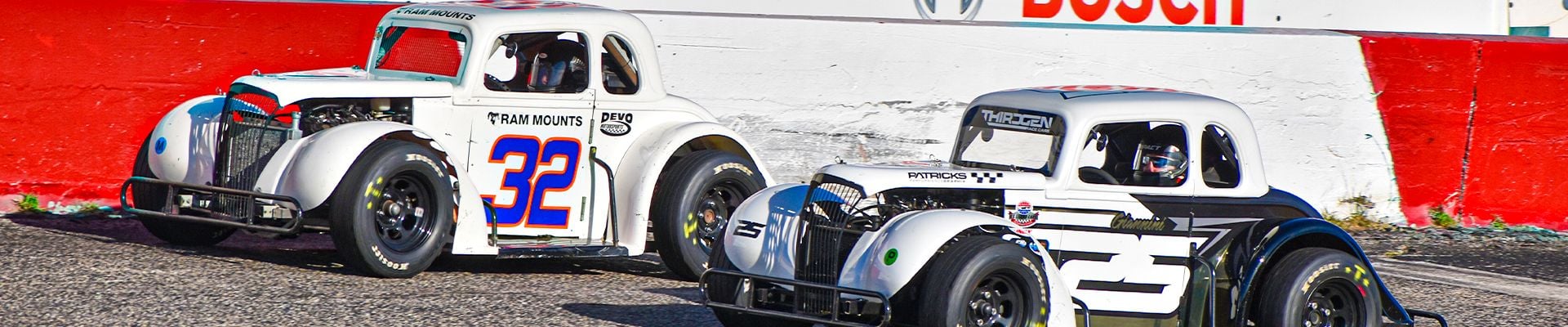
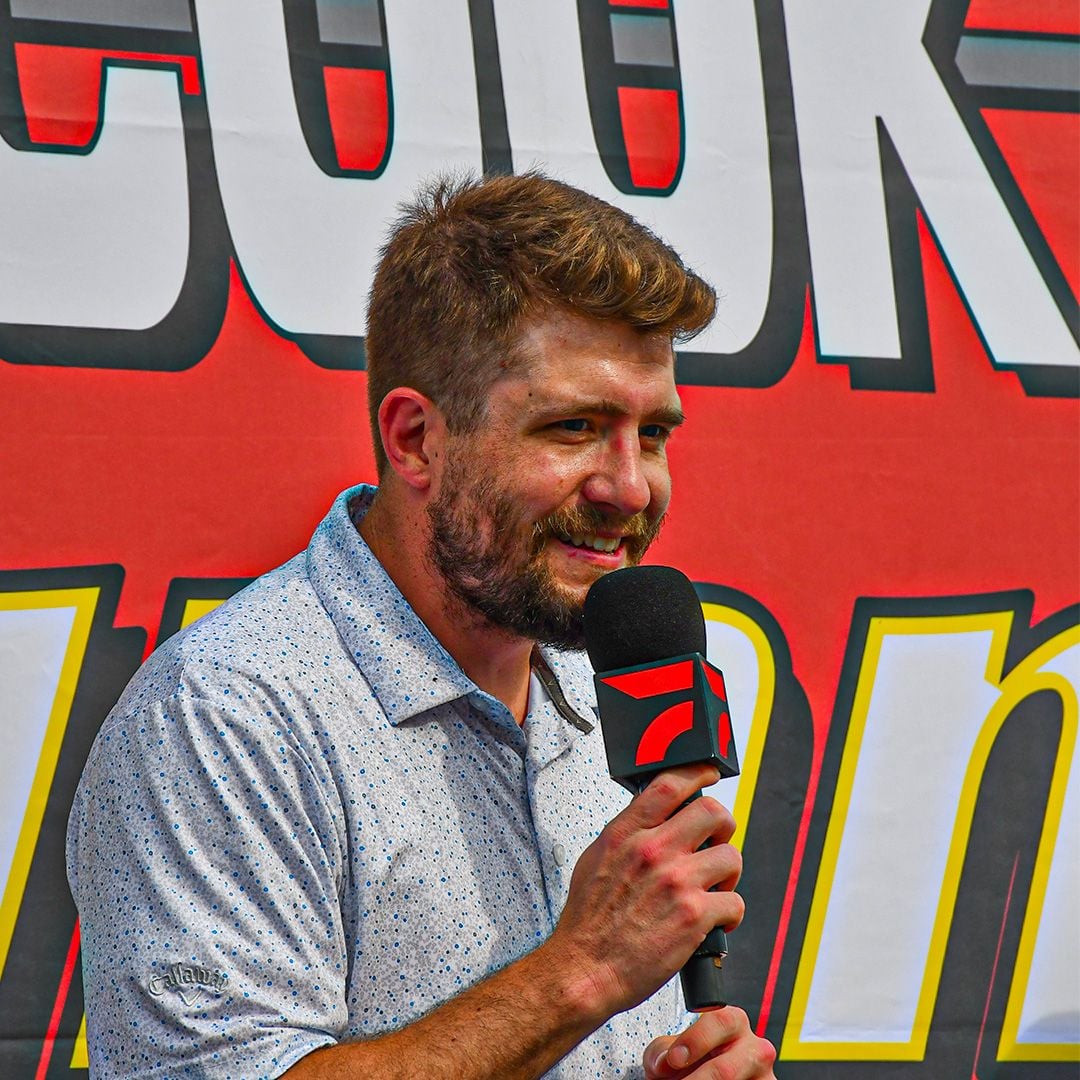
After starting off calling games in high school, David Styles has fallen in love and built his craft in broadcasting races. While working for PRN, he has spent time around the drivers and telling unique stories from around the pits, and on the track. Acting as this year’s Emcee for the Cook Out Summer Shootout, he was able to provide unique insights from winning drivers and help show that racing has a promising future.
Hometown: Canton, NC
Team: Performance Racing Network
Favorite Track: Bristol Motor Speedway
1. What inspired you to be in broadcasting and was motorsports the ultimate goal?
I started broadcasting high school basketball games in 2011.That came about, because I realized I wasn’t going to be able to play forever. I grew up in a motor sports family, my grandfather was a huge race fan, and my uncle helped our neighbor build race cars. Motor sports have always been a big part of my life, and it’s a great opportunity to cover it at all levels. I just like racing, anything with a car and an engine excites me.
2. What was your first broadcast and what do you remember?
I got on the headset and mixed it down because it was so loud in my ears. There is so much input happening at one time, learning the style of the play by play of my partner with me. In between breaks, he was coaching me up, and by the second or third game I was ready to go. After the first broadcast, we were on the air for roughly four or five hours, and I remember taking the headset off and having the biggest headache. It takes a few reps to get used to and you almost have to train your body to get used to it.
3. Who is a broadcaster that has inspired you?
Vin Scully is a really good one, the way he tells stories. My mentor Doug Rice, the anchor for PRN for 36 years. Being around him and guys like Brad Gillie, they really paint the picture. I am very much a radio guy, it's theater of the mind. You want to transport the listener from wherever they are to where you are covering the race. The sensations you get from being in the bowl or in the grandstands, you have to translate that to radio, and that to me is the most thrilling part of calling games.
4. Whether during or after college, what is the best advice a colleague has given you?
Get as many reps as you can. Say "yes" to as many opportunities that you can within reason. Take the opportunities that give you the best opportunity to grow. It may not be an on-air role, it might just be running a board, but if those come up, you should say yes to get the experience. Covering sports is not for everyone, it’s a grind. You don’t have a typical work schedule but get into and see if you like it.
5. This is your first Summer Shootout as Emcee, what is your biggest takeaway after eight weeks of racing?
It's seeing the up-and-coming drivers get their feet wet. Whether it was in the Bandoleros drivers, into the Legend Cars, and seeing drivers from the Chargers Division and seeing the drivers graduating out of that. Seeing the excitement that these kids have and driving the way that they do is really refreshing. It lets me know that motorsports are going to continue for many more years. We have a lot of kids still interested in working on cars and racing cars.
6. In your career so far, what has been a moment you have experienced that has reinforced your love for broadcasting?
I think getting to interview Christopher Bell in victory lane at Bristol during the truck race in the spring. The excitement he had for him and his owner, it was magical. You see how important it is to tell those stories, and how excited they are to win the race. Winning a race at any level is difficult, so to see gratification the teams have, and the ability to tell that story for the fans is paramount for me.
7. Working at PRN, do you have a preference between pit reporting and booth assignments?
They both offer different challenges. Pit reporting, you are finding the stories, you have your sets of cars to cover. You are listening to the scanners and pitching ideas to your race director. In the turns, you are just giving the play-by-play of what is going on in the race. It’s how the cars are running, what line are they on, who’s in first, who is moving up, and how each set of broadcasters are working together. In the pits you are more of a journalist adding nuggets to the race.
8. What has been your favorite or most interesting interview with a driver?
Alex Bowman at Bristol, after coming back from vertigo. It was great to see him back at the track, because that is a difficult illness to come back from. Sitting down with him and seeing how he was feeling and if he was happy to be back at the track, being human with these drivers. That’s how I approach it, I am there to be there friend and tell their stories. Catching up with him and telling his story was one of my favorite ones I have done, and it was my first one on air with PRN. The ones with Summer Shootout have been fun too, because they all get so excited. The Maverick Bradshaw ones were always fun because he would get out of the car and do some dance before talking with us. The Brandin Wrisley one was my favorite from the Shootout. Finally getting his win in the Masters Division after 40+ starts, his gratitude he had finally winning, and then learning he was retiring really sticks out to me.
9. What is a piece of advice you’d give a kid in the stands wanting to be a broadcaster when they grow up?
Go to your administration and see if they would be interested in putting a broadcast together. Get as many reps as possible. You have avenues now with the technology present for you to get reps, even if it’s you talking into your phone at a race or game. Take your phone and do a voice memo of you calling the game and listen back to your work and critique yourself on how you can improve. This is not something that you wake up and are good at, it takes a lot of work. Give yourself a list of things to work on and get better every chance you can. If you are in college, you have a lot of opportunities with your college athletic programs.
10. Given the opportunity, would you get behind the wheel of a Legend Car for a full-on test session?
Absolutely. I would love to drive one, I’ve ridden in a pace car with Brad Keselowski, and that was eye opening. Any chance for me to get on track action, I would be all for it. I have never been in a race car, but I would love to take some laps in a Legend Car, I think it would help me tremendously.
11. What would be your car number if you drove a race car?
I have a lot that I would really like. I was a big Terry Labonte fan, so the 5 is off the table because it has to much history. I am thinking something higher up the register like a 91 or 94. I would honestly like someone to assign me a number so I wouldn’t have to think about it. The most unique number I saw at the Shootout was Trent Dillard in the -34 which I thought was cool.
12. As motorsports is constantly evolving, what is an area on the broadcast side that you would like to see change in the future?
We are always striving to make our broadcast better, so technology wise we are already pretty high up. For calling a race, the scanner stuff can be a little iffy, but if I had a really good scanner with better abilities would be cool. I am very old school though, I still use a pen and paper, where my colleagues are usings iPads. Racing is in a good spot right now. For the cars, it’s whatever a new engineer can think of.